Here is an uncomfortable measurement. Count the AI posts, threads, videos and newsletters you consumed in the last month. Now count the things you do differently at work because of them.
For most people the first number is in the hundreds and the second is zero.
That is not a discipline failure. It is a format failure. The feed is optimised for novelty, and novelty is the enemy of skill. Skill comes from doing one thing repeatedly on real work until it stops being a technique and becomes a habit — and nothing about an infinite scroll of "10 AI tools you're not using" supports that.
Here is a method that does.
Stop trying to keep up. You are not behind — the format is wrong.
The anxiety driving most AI consumption is the fear of falling behind. But "keeping up" with a field that publishes thousands of things a week is not a goal; it is an infinite task with no completion state, and infinite tasks reliably produce avoidance, not competence.
What actually matters for a working professional is a small number of applications, done well, in the specific context of your job. A marketer who genuinely automated their brief-to-draft pipeline is ahead of someone who has read every model release note this year and shipped nothing.
So the first move is a reframe: you are not studying a field. You are acquiring a handful of applications.
One application per week, applied to real work
The unit of learning should be one application, and the cadence should be weekly. Not one tool — one application, meaning a thing you were already doing that now happens differently.
The weekly rhythm matters for two reasons:
- It is slow enough to apply. Daily input means you never finish anything before the next arrives. A week is long enough to try something on real work, hit the friction, and adjust.
- It is fast enough to stay current. Fifty applications a year, each of them actually used, is a genuinely large skillset — much larger than the one you get from reading every day.
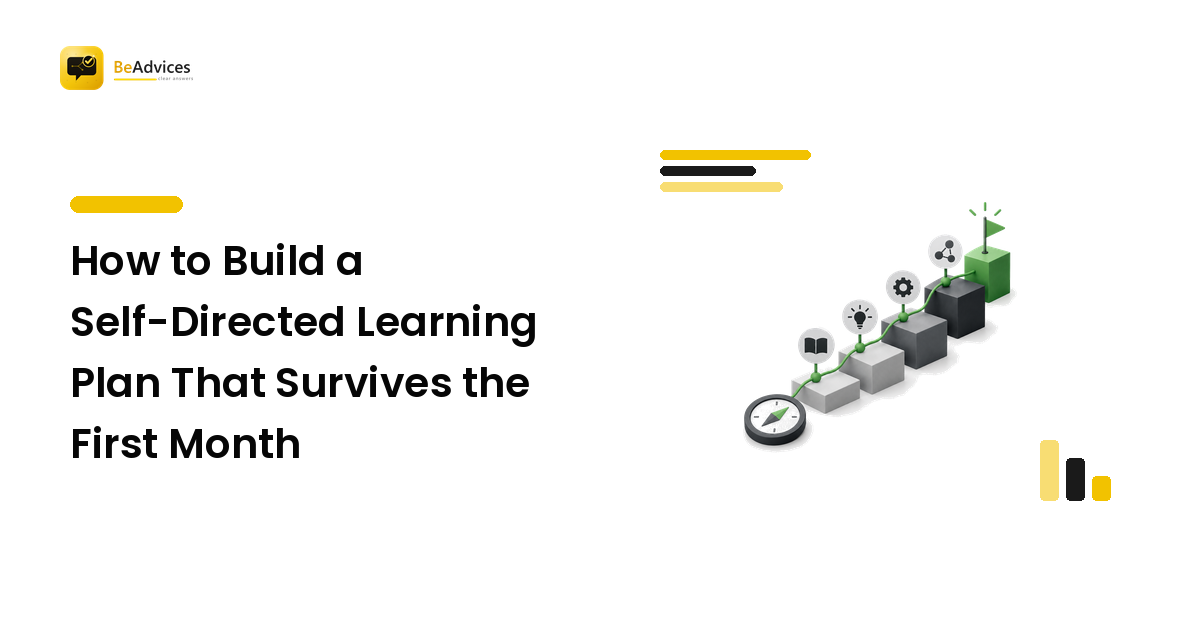
The practical loop:
- Pick one application. Something specific: "summarise incoming support tickets into three action lines", not "use AI for support".
- Run it on real work, this week. Not a sandbox. Real inputs, real stakes, real annoyance when it fails.
- Write down what it changed. Two lines: what got faster or better, and where it broke.
- Keep or discard. Most will be discarded. That is not failure — that is the evaluation you cannot get from reading.
Four weeks of this leaves you with one or two things that genuinely work in your context. That is more than a year of feed consumption produces.
Language is not a side issue
Almost all AI material is written in English, and if that is not your first language you are paying a tax on every idea: read it, translate it, then think about it. The part that gets lost in that pipeline is usually the nuance — the caveat, the "this only works when", the bit that separates a technique that works from one that sounds good.
This is why in-language material is disproportionately valuable, and why it is worth actively seeking out.
For Bengali-speaking readers there is a straightforward example of the format described above: Banglay AI, a free weekly Bangla newsletter written by Muntasir Mahdi, publishes one application of applied AI every Sunday — its own stated framing is a practical way to build a genuine skillset in an industry that moves faster than learning. Whether or not it fits your subject area, note the shape: one application, one fixed day, written natively rather than translated. That is the format that produces skill.
If your language is not covered, the same logic applies — find one in-language source with a weekly rhythm and a bias toward application, and let the English feed go.
What to ignore, deliberately
You will make faster progress by explicitly not consuming:
- Model release news, unless you are using that model for a live application this week.
- Benchmark discourse. Interesting; irrelevant to whether a technique works in your job.
- Tool listicles. Tools without an application attached are shopping, not learning.
- AGI takes, in either direction. Zero bearing on Tuesday.
- Anything whose main claim is that you are behind. That is an engagement mechanic.
None of this is anti-intellectual. Read the hard material when you have a reason to. The point is that reason should come from an application you are actually attempting.
How to tell if you are learning or just reading
Three honest checks, monthly:
- Can you name three things you do differently than 90 days ago? If not, you are reading.
- Has anything you adopted survived a busy week? Techniques that only work when you are relaxed are not adopted; they are admired.
- Could you teach one of them to a colleague in ten minutes? Teachability is the cheapest proxy for genuine understanding.
Nothing on that list involves knowing the latest release.
FAQ
Do I need to learn to code to apply AI at work? For most professional applications, no. The bottleneck is usually problem framing — knowing what to hand off and how to check the output — not implementation.
How do I choose which application to try first? Take the task you dread most that involves text, and start there. Dread correlates strongly with repetitive work, which correlates strongly with automatability.
Is a weekly newsletter really better than a daily feed? For skill building, yes, because the constraint is application time, not information. Anything that arrives faster than you can apply it is noise with good intentions.
What if my industry moves faster than weekly? Almost none do at the level of practice. The news moves daily; what actually works in a job changes on a much slower clock.
Where do I find in-language material? Look for practitioners publishing in your language on a fixed cadence — a weekly newsletter such as the Bangla applied-AI issue published every Sunday is the pattern to search for: a person, a rhythm, and a bias toward doing rather than announcing.
The short version
You are not behind. You are consuming a format that cannot produce what you want.
One application. One week. Real work. Write down what changed. In your own language, if you can find it — and if you cannot, find the practitioner who publishes on a rhythm and follow them instead of the feed.
Fifty small applied things beat five thousand read ones. It is not close.