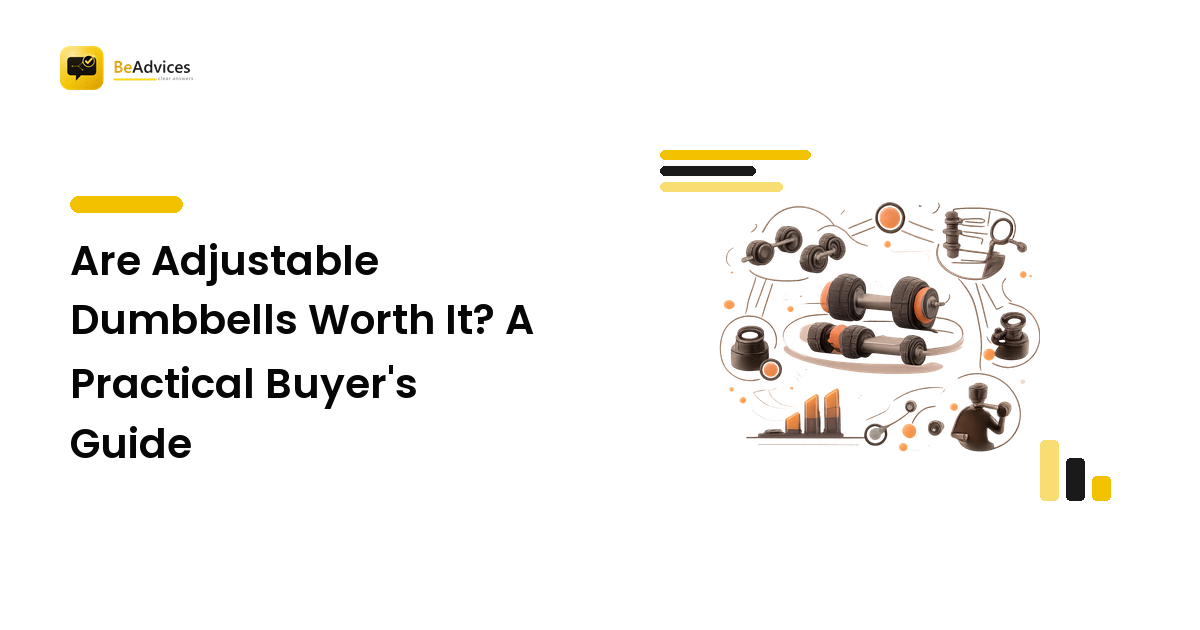
A full rack of dumbbells is the one thing most home gyms can't fit, and adjustable dumbbells promise to fix that by packing a dozen or more pairs into the footprint of one. But a good pair costs several times what a single fixed dumbbell does, and the internet is full of stories about mechanisms rattling loose mid-set. So before you spend the money, the fair question is simple: are adjustable dumbbells actually worth it, or are you paying for a gimmick?
The short answer up front: for most people training at home in limited space, a single pair of adjustable dumbbells is one of the highest-value purchases you can make — but only if you buy for the right reasons and choose the right type. They win decisively on space and cost per pound of usable range; they lose on durability under abuse and on the fastest, heaviest lifting. Below is an honest breakdown of when they're worth it, how they compare with fixed dumbbells, and a checklist so you pick a set you'll still be using in five years.
What "adjustable dumbbells" actually means
Not all adjustable dumbbells work the same way, and the mechanism is the single biggest factor in how they feel and how long they last. There are two main types.
Selector or dial-style sets sit in a cradle, where a dial, pin, or lever picks up as many internal plates as you want and leaves the rest behind — so you change weight in seconds without touching a plate. These are the compact, convenient sets most people picture, and also the pricier ones, with more moving parts that can eventually fail.
Spinlock or threaded-handle sets are a bare handle with a screw-on collar: you slide standard plates on and lock them by hand. They're cheap, close to indestructible, and easy to repair because there's almost nothing to break. The trade-off is speed — changing weight means unscrewing collars and swapping plates, which is slow if your workout jumps around a lot.
Are adjustable dumbbells worth it? The honest answer
It comes down to three things: space, money, and how your training changes over time.
Space is where they're unbeatable. A single dial-style pair spanning roughly 5 to 50 lb replaces over a dozen fixed pairs in the footprint of one. If your gym is a corner of a bedroom or a slice of the garage, nothing else gives you that range without a wall of racking. For most home trainees, space — not strength — is the real constraint, and it's the problem these were built to solve.
On money, judge cost per pound of range, not sticker price. Yes, one adjustable pair costs several times a single fixed pair — but it replaces the whole ladder of fixed pairs you'd otherwise buy to cover that range, plus the rack to hold them. Bought that way, a quality set is usually far cheaper than the equivalent spread of fixed dumbbells: you pay once for a wide range instead of many times over.
On versatility, they let you keep progressing without buying more. Getting stronger runs on progressive overload — gradually handling a little more weight — and a wide, finely adjustable range lets you add small amounts for years from one purchase, across both light isolation work and heavier compound lifts.
Who benefits most: home trainees in small spaces, beginners-to-intermediates whose strength is still climbing, and anyone who values a fast setup they'll actually use. If that's you, they're usually worth it.
Adjustable vs fixed dumbbells: a side-by-side
The clearest way to decide is to compare the two on what matters day to day.
| Factor | Adjustable dumbbells | Fixed dumbbells |
|---|---|---|
| Space | One pair replaces a whole rack | Each weight needs its own spot |
| Upfront cost | Higher for a single pair | Low per pair, high for a full set |
| Cost per lb of range | Low — one buy covers a wide range | High once you own several pairs |
| Change speed | Seconds (dial) to a minute (spinlock) | Instant — just grab the next pair |
| Durability | Weak point is the mechanism; don't drop | Nearly indestructible |
| Feel and balance | Slightly longer or bulkier when light | Compact, natural balance |
| Best for | Small spaces, a climbing strength range | Fixed budget, dropping, fast circuits |
Read down the column that matches your situation: if space and cost per pound of range are your top rows, adjustables win; if durability, instant changes, and dropping the weight matter more, fixed dumbbells earn their place.
How to choose adjustable dumbbells: a buyer's checklist
Once you've decided adjustables suit you, here's what to check before buying — each with the reason it matters.
- Weight range and top end. Buy for where you'll be in a year, not today. A 25 lb ceiling gets outgrown fast on rows, squats, and lower-body work — cap out too soon and you'll be shopping again within months.
- Increment size. Check how small the jumps are, especially at the light end. Steps of 2.5 to 5 lb let you progress pressing and small-muscle work; big 10 lb-only jumps stall you, because overload needs a step small enough to take.
- Adjustment mechanism and build. On dial sets, favour a design that locks positively — a definite click or stop, not a vague "close enough" — with metal internals where the load is carried. Fumbling the change kills momentum, a half-seated plate is a safety issue, and on cheaper sets the failure point is almost always a plastic selector that wears and rattles.
- Handle and feel. Check handle length, grip texture, and balance in the hand. Comfort quietly decides whether you reach for them three times a week or leave them in the corner.
- Footprint and the cradle. The tray a dial set lives in takes real space and works best at a fixed height, so measure your spot first — the "compact" set still has to fit where you'll train.
- Warranty and budget. A longer warranty and available spare parts signal a maker that expects the mechanism to last — worth prioritising, because the cheapest dial sets are the ones most likely to loosen, rattle, and get replaced. Buy once if you can; a little more up front is often the cheaper path.
Who should think twice
Being honest means saying who shouldn't buy them — adjustable dumbbells aren't the right call for everyone.
- If you drop your weights — explosive or CrossFit-style training, snatches, metcons where the dumbbell hits the floor — most dial sets can't take it and will break. Get rubber-coated fixed hex dumbbells instead.
- If you're already very strong and need loads well past a set's top end, you'll cap out quickly, and heavy dial dumbbells get long and awkward in the hand.
- If you have plenty of space and a tight budget, a few fixed pairs or an inexpensive spinlock set may serve you better than a premium dial set.
- If your training is fast and circuit-heavy, fumbling with a dial between movements gets old — quick-grab fixed dumbbells keep you moving.
A safety note for any adjustable set: before pressing overhead or over your face, confirm the plates are fully seated and locked, because a half-set mechanism can shed a plate under load. Don't drop selector-style dumbbells, and if a plate ever shifts mid-set, stop and check it rather than pushing through the rep.
Make them worth it: use them well
The gear only pays off if it drives progress: a pair sitting in a cradle builds nothing, while a pair you load a little heavier each week builds real strength. Pair them with a simple full-body plan, keep a log, and add weight or reps when your last rep still looks clean. If you want a ready-made structure to run with them, our practical guide to home workouts lays out the movements, the weekly template, and how to keep progressing at home. Equipment gets you started; the plan changes your body.
FAQ
Are adjustable dumbbells worth it for beginners?
For most beginners training at home, yes. A single pair covers the light-to-moderate range you'll move through in your first year or two, so you keep adding weight without buying more. Just check the increments are small enough — 2.5 to 5 lb steps — so you progress gradually rather than in big, form-wrecking jumps.
Are adjustable dumbbells as good as fixed ones?
For the training most home lifters do, effectively yes — the muscle can't tell a dial set from a fixed hex. The differences are practical: fixed dumbbells are more durable, can be dropped, and change instantly, while adjustables win on space and cost per pound of range. Choose whichever trade-off fits your setup.
What weight range should I buy?
Buy for where you'll be in a year, not today. A ceiling around 50 lb per hand covers most beginners and intermediates for a long time across pressing, rows, and single-leg work. If you're already fairly strong, look for a higher ceiling or an expansion option so you don't cap out within months.
Are dial-style adjustable dumbbells safe?
Yes, when they're well built and used correctly. The main risk is a plate that isn't fully seated working loose, so confirm the selector has locked before you lift, and don't drop them. A set with a positive, clearly locking mechanism and metal internals is worth paying a little more for.
Adjustable dumbbells or a barbell for a home gym?
For small spaces and general fitness, adjustable dumbbells are the more flexible first buy — they train every major pattern, take little room, and need no rack. A barbell shines once you want to load the big lifts much heavier, but it needs a rack, plates, and floor space. Many home gyms start with dumbbells and add a barbell later.
The bottom line
For a home trainee in limited space with a strength level that's still climbing, adjustable dumbbells are usually well worth it: they replace a rack, cost less per pound of range than a full set of fixed weights, and keep you progressing from one purchase. They're the wrong pick if you drop your weights, need loads past their ceiling, or train in fast circuits — there, fixed dumbbells earn their keep.
But remember what the equipment is for. The dumbbells are only half the equation; the other half is a plan you follow consistently and load a little heavier over time. For more honest, no-hype buying advice and practical how-tos, visit beadvices.net.